2026-11-04
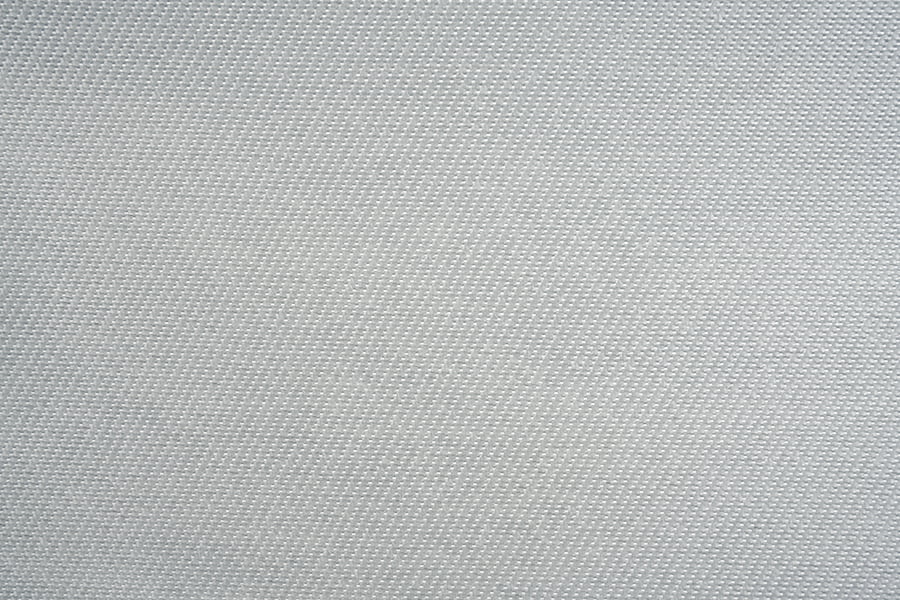
Fiberglass screen cloth is a plain-weave fabric woven from C-glass or E-glass yarns, heat-cleaned to burn off the sizing applied during fiber drawing, then coated with PVC or vinyl so the polymer locks every warp and weft crossover in place. The coating is what separates screen cloth from raw glass fabric: it stops yarns from shifting, protects filaments from abrasion at the crossover points, and carries the finished colour.
Three structural decisions set every downstream performance value. Yarn linear density, quoted in tex, fixes the filament bundle size and therefore the fabric weight and the breaking force the weave can reach. Weave architecture - plain weave for almost all insect screen, with twill and leno variants used where mesh stability or tear strength matters more than airflow - sets how the yarns interlock and how much crimp each one carries. Coating mass determines how much of the aperture the polymer closes and how well the cloth survives flexing around a frame.
Mesh structure decides four outcomes at once:
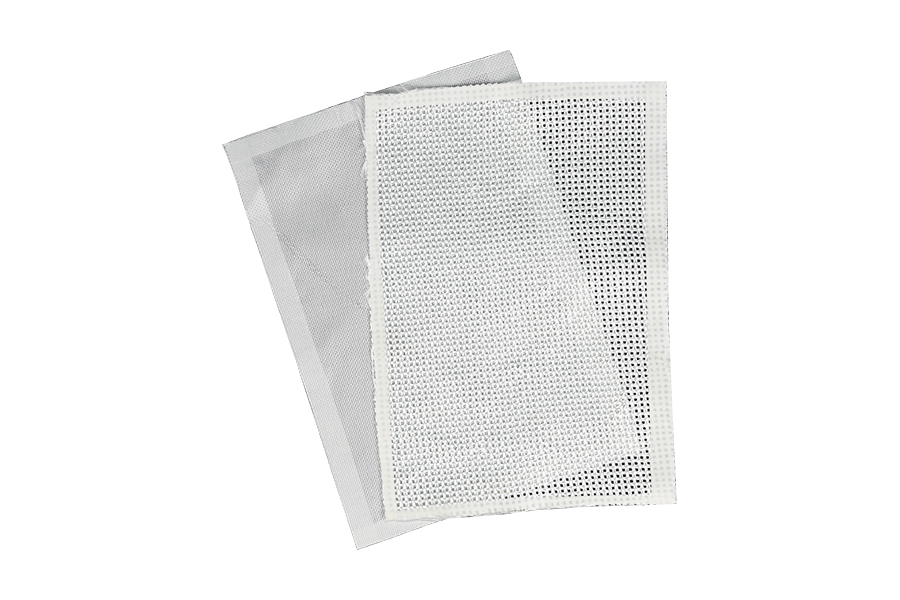
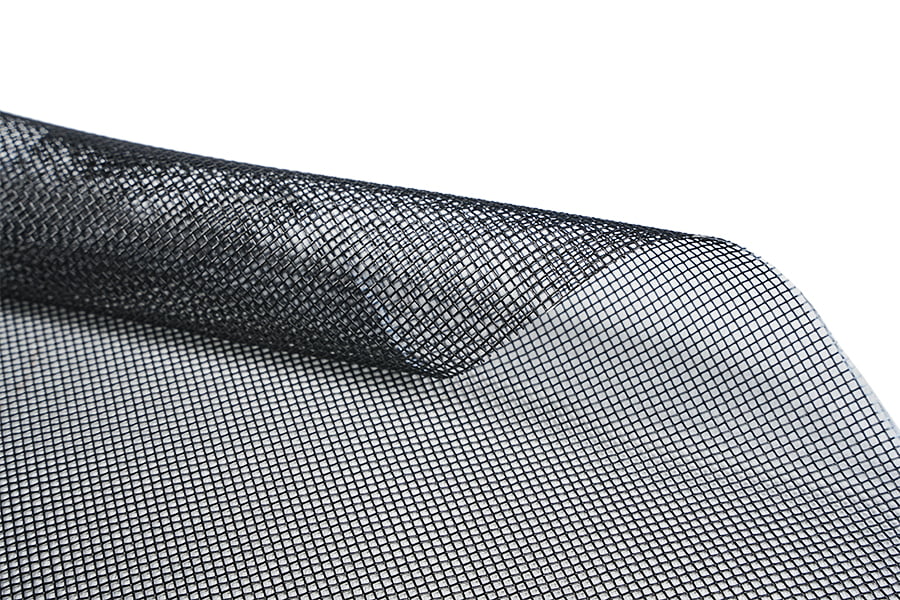 Durable Fiberglass Insect Screen in Black PVC SeriesThis coated fiberglass plain-weave insect screen suits screen windows and ventilation openings, with mesh structure relevant to open-area calculations.View Product →
Mesh count alone does not predict performance. Running the arithmetic on four common constructions shows that a finer count can carry a larger open area than a coarser one, because yarn diameter changes with the count: 18 x 18 with 0.28 mm yarn lands at roughly 64 percent open area, while 20 x 20 with 0.23 mm yarn reaches about 67 percent.
Both figures come from the same two-step calculation. Convert count to pitch first, then subtract the yarn diameter:
| Construction | Yarns per 25.4 mm | Yarn diameter | Clear aperture | Open area | Typical use |
|---|---|---|---|---|---|
| 18 x 16 | 18 warp / 16 weft | 0.28 mm | 1.13 mm warp / 1.31 mm weft | 66% | General window and door screening |
| 18 x 18 | 18 warp / 18 weft | 0.28 mm | 1.13 mm | 64% | Balanced weave with firmer edge stability |
| 20 x 20 | 20 warp / 20 weft | 0.23 mm | 1.04 mm | 67% | Finer exclusion while holding airflow |
| 20 x 22 | 20 warp / 22 weft | 0.23 mm | 1.04 mm warp / 0.92 mm weft | 54% | Biting midge and no-see-um control |
Aperture and open area values here are calculated from the stated yarn diameters, not measured from a specific production roll. When airflow sits inside a performance envelope, ask for a measured air permeability report rather than accepting a mesh count as proof.
A workable fiberglass screen cloth specification names a test method and an acceptance value for at least six properties: areal weight, tensile breaking force, tear resistance, coating mass, air permeability and UV retention. Without the method named, two labs can test the same roll and report numbers that cannot be compared.
| Property | Reference method | What the specification must state |
|---|---|---|
| Areal weight | ISO 3801 or ASTM D3776 | Target in g/m2, the tolerance band, and the number of specimens per roll or batch |
| Tensile breaking force | ASTM D5035 or ISO 13934-1 | Strip width (25 mm or 50 mm), gauge length, and separate warp and weft minimums |
| Tear resistance | ASTM D5587 trapezoid | Direction tested and the minimum force the weave must hold |
| Air permeability | ASTM D737 or ISO 9237 | Differential pressure, commonly 125 Pa, and the tested area |
| Coating mass | Gravimetric ignition loss | Coating share of finished weight and the burn-off temperature used |
| UV retention | ASTM G154 with UVA-340 lamps | Exposure hours and the minimum retained tensile percentage |
| Surface burning | ASTM E84 or GB 8624 | Required class, for example Class A (flame spread index 25 or below) or B1 |
| Light fastness | ISO 105-B02 | Minimum blue wool grade for dyed or pigmented cloth |
Four failure patterns account for most fiberglass screen complaints, and each one maps to a structural variable that a count-only specification never controls. The comparison below separates constructions that survive service from those that fail early.
Mesh structure is not set at the loom alone; five process stages can each shift the aperture away from the target, and the coating stage moves it the most. A buyer auditing a supplier is auditing this sequence.
Jiaxing Jiete New Material Co., Ltd., a fiberglass fabric manufacturer based in Haining, Zhejiang, states a plant of about 150,000 square meters, more than 200 employees and roughly 200 production machines, including Karl Mayer warping and sizing machines, air-jet looms, Dornier rapier looms and several coating lines. That equipment set covers the full sequence above from yarn preparation through coating, which matters when a purchase order needs the aperture held across a long production run rather than only in a sample.
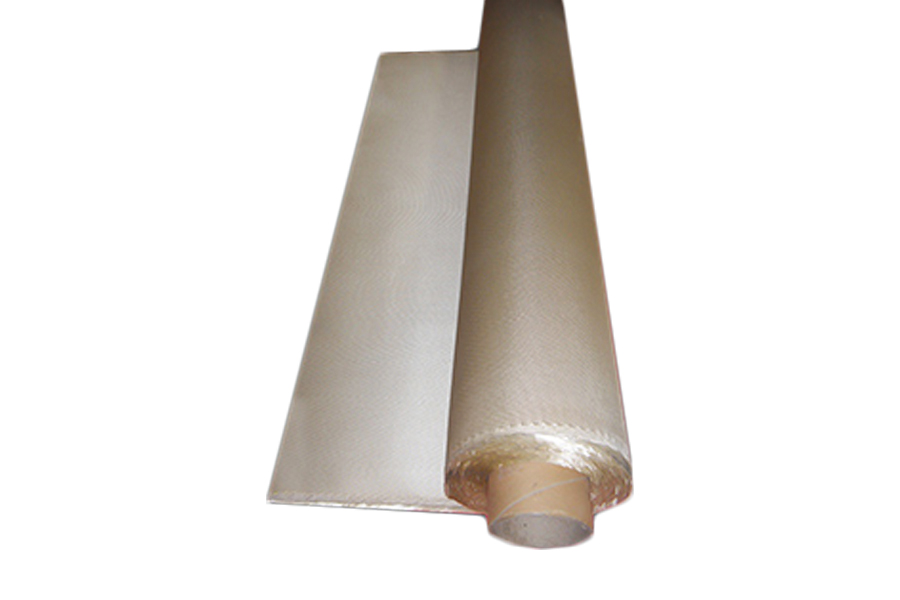
 Acrylic Coated Alkali-Proof Fiberglass Mesh ClothC-glass or E-glass plain-weave mesh with acrylic coating; review mesh opening, width and roll length details before requesting quotations.View Product →
An RFQ that lists mesh count, width and colour will attract quotations that are not comparable. Adding seven items turns the quotation into a specification check, and a fuller parameter list is set out in this guide to fiberglass fabric specifications for RFQs.
18 x 16 remains the default for window and door screening in North America, and it is the count most fiberglass screen cloth is woven to. Where biting midges are the target, move to 20 x 20 or 20 x 22, which brings the smaller aperture below 1.0 mm when a 0.23 mm yarn is used. State count, yarn diameter and coating mass together, because the count on its own leaves the aperture range unresolved.
No. Open area depends on pitch minus yarn diameter, so a finer mesh woven with thinner yarn can pass as much air as a coarser mesh built with thicker yarn. At 18 x 18 with 0.28 mm yarn the calculated open area is 64 percent; at 20 x 20 with 0.23 mm yarn it is about 67 percent. When airflow is a design constraint, specify a minimum air permeability under ASTM D737 at 125 Pa instead of relying on a mesh count.
Name ASTM D5035 or ISO 13934-1 for tensile breaking force with the strip width and gauge length, ASTM D5587 for trapezoid tear, ASTM D737 or ISO 9237 for air permeability, ISO 3801 or ASTM D3776 for areal weight, and ASTM G154 with UVA-340 lamps for UV retention. Conditioning follows ASTM D1776 at 21 C and 65 percent relative humidity, so results from an unconditioned sample cannot be compared with conditioned data.
Both start on the same looms, but the finishing route splits. Composite mesh keeps a silane-based sizing so resin can bond to the glass, while screen cloth is heat-cleaned and PVC coated, which blocks resin adhesion but delivers flexibility, colour and abrasion resistance. Alkali resistance follows the glass type as well: C-glass is selected for humid and coastal screening, while E-glass is chosen where higher tensile strength matters more than chemical durability.
Recommended Products
Copyright © 2025 Jiaxing Jiete New Material Co., Ltd. All Rights Reserved.
Wholesale Wide Width Fiberglass Cloth Roll Suppliers



 English
 中文简体