2026-11-18
Two rolls can both be invoiced as fiberglass mesh fabric and still sit six aperture sizes apart. At a 0.50 mm nominal yarn diameter, a 4 x 4 per inch weave leaves a 5.85 mm opening; an 18 x 18 weave of the same yarn leaves 0.91 mm. Tensile breaking force per 50 mm, coating pickup and alkali retention swing just as widely once the glass type and the finish change. The specification you write, not the product name on the packing list, decides which roll arrives.
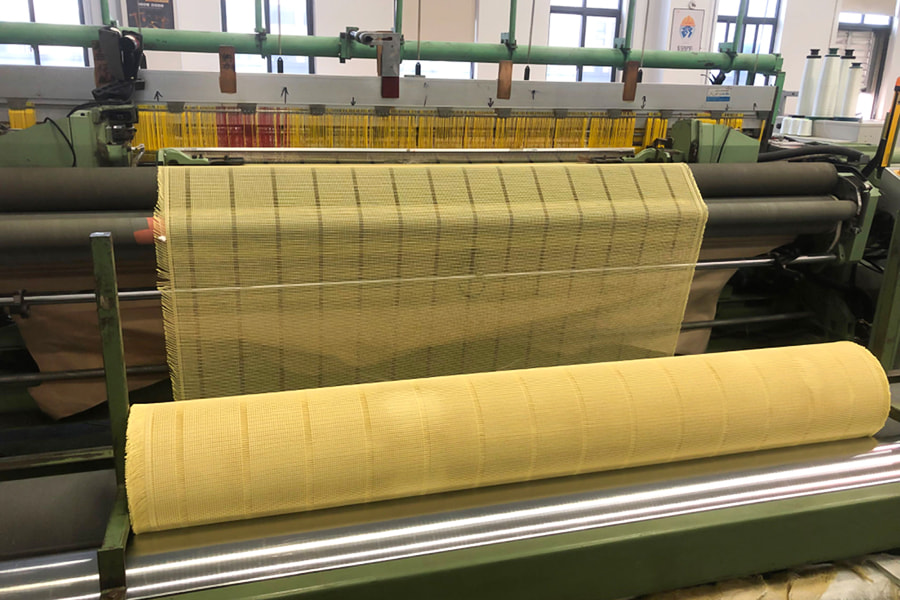
Fiberglass mesh fabric is a woven glass textile with deliberate, uniform gaps between the warp and weft yarns, so the finished roll behaves as a grid rather than as a solid laminate ply.
Fiberglass mesh fabric: a plain- or twill-woven textile made from continuous-filament glass yarns, defined by an open aperture, a stated yarn count per centimetre in both directions, and an optional polymer, silicone or mineral coating applied after weaving.
Buyers meet the same material under two very different specifications. Reinforcement mesh is woven from heavier yarns, commonly 68 tex and above, leaving apertures of roughly 2 mm to 6 mm, and it is judged on tensile breaking force per 50 mm. Screen and filtration mesh is woven from finer yarns at tighter counts and is judged on aperture size, open area and permeability. Quoting one against the other without the yarn designation attached produces numbers that cannot be compared.
The yarn itself carries a standard designation under ISO 2078. A code such as EC9 68 reads as E-glass, continuous filament, 9 micron filament diameter, 68 tex linear density. Every performance figure on a mesh datasheet traces back to four inputs:
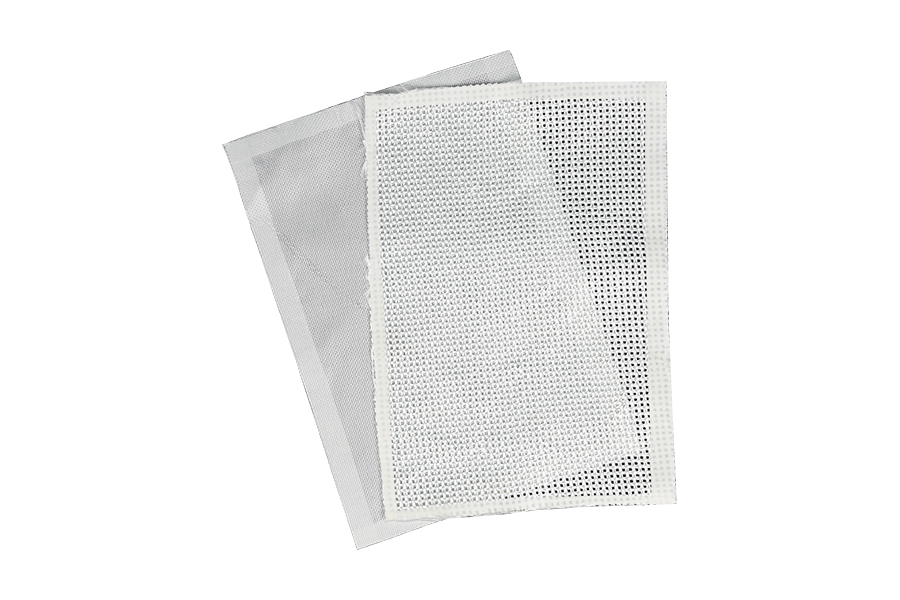 Custom Fiberglass Mesh Cloth and Screen ClothCustomizable fiberglass mesh and screen cloth in multiple apertures, widths, weaves, and coatings for cement, plaster, waterproofing, and screening uses.View Product →
E-glass is the default grade for woven mesh, and it is the wrong choice wherever the mesh will sit against alkaline cement pore water, where AR-glass is the specified material.
ASTM D578 covers glass fibre strand designation for E-glass and related grades, and ISO 2078 assigns the code letters used in yarn and fabric descriptions. The practical difference between the families is oxide chemistry, and it shows up as service life rather than as an initial tensile figure.
| ISO 2078 code | Glass family | Alkali resistance | Typical mesh application |
| E | E-glass, borosilicate | Low in cementitious pore water | Composite laminates, general filtration, insect screen |
| C | C-glass, higher chemical durability | Moderate; acids handled better than E | Chemical-duty filtration mesh |
| ECR | ECR-glass, boron-free | Higher than E in both acid and alkali | Long-life industrial and environmental mesh |
| AR | AR-glass, zirconia-bearing | High; the grade used against concrete | Rendering mesh, cementitious reinforcement |
Where alkali exposure is unavoidable, the mesh requested is normally an alkali-resistant product such as an alkali-resistant fiberglass cloth roll, in which the AR-glass yarn is combined with a coating that shields the filament surface from the surrounding matrix.
Seven measured values decide whether a mesh meets its structural requirement: yarn count, mass per unit area, thickness, tensile breaking force, elongation at break, coating pickup, and tensile retention after alkaline ageing. Each one has a reference method, and a datasheet that omits the method is not comparable with a competitor's sheet.
| Measured property | Reference method | What it controls |
| Yarn count, warp x weft per cm | ISO 4602 | Aperture size, open area, resin and render keying |
| Mass per unit area, g/m2 | Gravimetric on a conditioned sample | Material content and the price basis of the roll |
| Thickness, mm | ISO 4603 | Coating build, handle, roll set and lay-up drape |
| Tensile breaking force, N/50 mm | ISO 4606 strip method, ASTM D5035 | Load capacity in the tested direction |
| Elongation at break, percent | Same specimen as the tensile test | Crack-bridging behaviour in render and plaster |
| Combustible matter, percent | ISO 1887 | Coating pickup, finish level and fire behaviour |
| Tensile retention after ageing, percent | EN 13496 ageing procedure | Service life in cementitious and alkaline systems |
Tensile breaking force is the figure buyers compare first, and it only means something with the specimen geometry stated. The strip method tests a 50 mm wide specimen at a 200 mm gauge length and reports the result in newtons per 50 mm; a result quoted without width and gauge length cannot be checked against another supplier, and values measured on a different geometry are not interchangeable. Warp and weft are tested separately, because an unbalanced weave will pass in one direction and fail in the other.
EN 13496 covers both the tensile test on glass fibre meshes and an accelerated ageing procedure in alkaline solution. The number that matters on a datasheet is the retention percentage, not the initial strength alone, because a heavy E-glass mesh with a high initial tensile value can fall below a lighter AR-glass mesh once both have been aged. Best practice is to publish the initial value and the aged value side by side.
Aperture is fixed by mesh count and yarn diameter, and it is the property that controls resin flow, render keying and filtration rate.
Calculated aperture against mesh count at a 0.50 mm nominal yarn diameter
Illustrative calculation example: aperture in mm equals 25.4 divided by mesh count per inch, minus the nominal yarn diameter. Yarn diameter is held constant at 0.50 mm for comparison, so these are geometric results rather than product specifications.
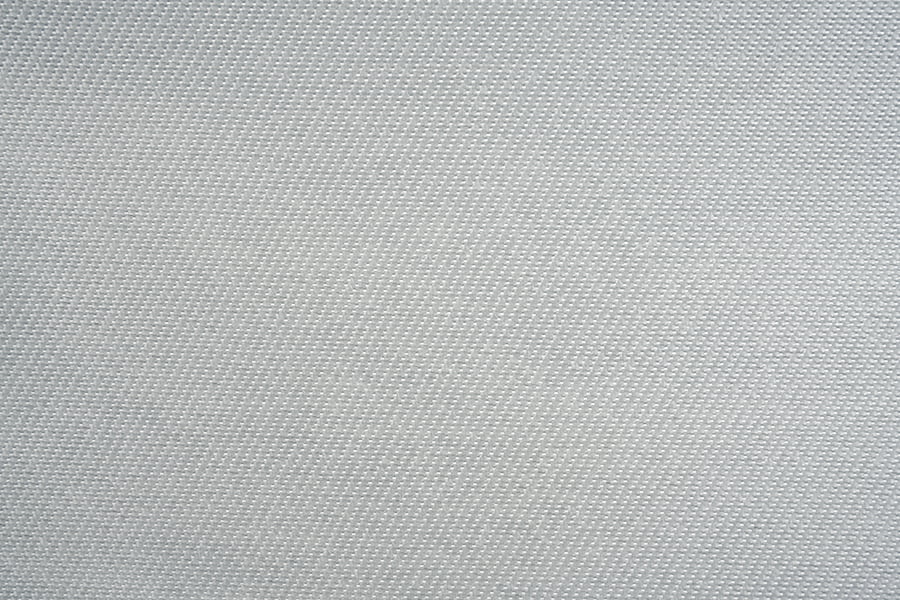
The formula explains why mesh count alone is a poor buying criterion. Two fabrics can carry the same 8 x 8 count and still differ in aperture by more than a millimetre if one is woven from 0.35 mm yarn and the other from 0.70 mm yarn. Weave pattern compounds this: a plain weave interlaces every yarn and produces a flat, dimensionally stable grid, while a twill weave crosses less often, gives a thicker fabric with better drape, and shifts the balance between warp and weft strength.
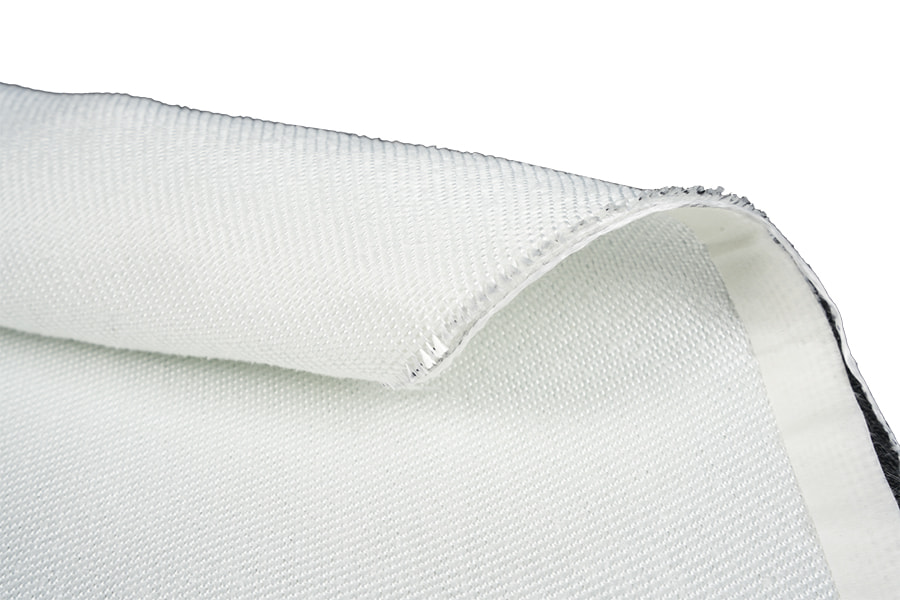 Chemical-Resistant Expanded Fiberglass Filter FabricOpen-mesh E-glass or C-glass filter fabric with chemical-resistant finish, high permeability, and low pressure drop for corrosive filtration and separator applications.View Product →
A coating changes mesh performance more than a weave change does, because it controls filament protection, adhesion to the surrounding matrix, and resistance to heat, water and chemicals.
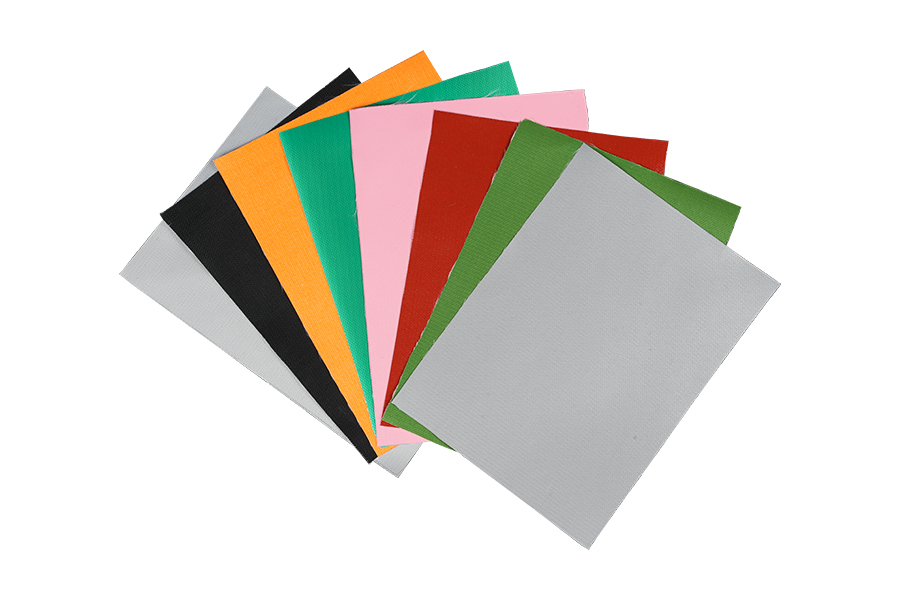
Coating pickup is measured as combustible matter content under ISO 1887 and is quoted as a percentage of the finished fabric mass. Acrylic, PVAc and SBR finishes are the standard protective coatings for reinforcement mesh. Silicone, PTFE, PVC, PU and vermiculite coatings move the mesh into higher-temperature, chemical or outdoor duty. Over-coating is a real failure mode: a coating heavy enough to bridge the aperture turns an open grid into a closed sheet and removes the mechanical keying that made it useful.
Open aperture is fully preserved, weight and cost per square metre are at the lowest level, and the fabric is easy to inspect visually. Filaments are unprotected, abrasion resistance is low, and unprotected surfaces lose strength faster in wet alkaline or humid conditions.
Filaments are shielded, tensile retention after ageing improves, and handling and cut-edge fraying are reduced. Coating adds mass and cost, can narrow the aperture, and must be matched to the service temperature and the matrix chemistry it will contact.
 Durable Waterproof PU-Coated Fiberglass FabricPU-coated glass-fiber cloth combines waterproofing, flexibility, and tear, corrosion, wear, and weather resistance for industrial, construction, and environmental protection uses.View Product →
A mesh order that states nine parameters removes almost every source of dispute at goods-in inspection, and suppliers such as Jiaxing Jiete New Material Co., Ltd. can confirm each one against production records.
For a consolidated specification template, the parameter list published as fiberglass fabric specifications for RFQs maps directly onto the items above and can be attached as an annex to the enquiry.
No. Tensile breaking force scales with yarn cross-section and yarn count together, not with count alone. A 10 x 10 mesh woven from 68 tex yarn can carry less load than a 5 x 5 mesh woven from 200 tex yarn, so the comparison has to be made in N/50 mm at a stated yarn designation, with the specimen width and gauge length published.
Aperture. Solid cloth is woven so that warp and weft sit against each other and the fabric is effectively closed, while mesh fabric is woven to a controlled open area. Mass per unit area, tensile force and coating content are measured the same way on both under ISO 4602, ISO 4603, ISO 4606 and ISO 1887, which is what makes the two comparable on a datasheet.
The correct pickup is the one the application needs, measured as combustible matter content under ISO 1887 and reported as a percentage of finished fabric mass. Reinforcement meshes typically need enough coating to protect filaments through alkaline ageing while keeping the aperture open; heavy coatings that close the grid defeat the mechanical keying function of the mesh. Confirm the target percentage with the supplier before the batch is woven rather than after.
At minimum ISO 4602 for yarn count, ISO 4603 for thickness, ISO 4606 for strip tensile breaking force and elongation, and ISO 1887 for coating pickup. Where the mesh is used against cementitious material, EN 13496 should also be cited for both the tensile test and the accelerated alkaline ageing result. A datasheet citing ASTM D5035 instead of ISO 4606 is acceptable provided the specimen width, gauge length and test speed are all stated.
Recommended Products
Copyright © 2025 Jiaxing Jiete New Material Co., Ltd. All Rights Reserved.
Wholesale Wide Width Fiberglass Cloth Roll Suppliers



 English
 中文简体